
When a car travels down the road, it appears to race forward, with its wet tires becoming more noticeable on the rough surface. When a typhoon approaches a community, fear settles in long before the first winds arrive and lingers even after the storm has passed. Its aftermath is written across the city. Shattered walls, broken windows, and lives forever altered. Livelihoods collapse, living standards fall, and no words are needed to confirm the damage. You can see it with your own eyes. The pain is depicted through the picture.

Science shows how each action in our lives shapes us into who we become at a given point. Every reaction carried out by the atoms in our bodies today is, in some way, a response to what was once an action. What was once taught, what once happened to this life. It is neither unconscious nor unknown. It lies deep beneath the buried layers of the known, and it remains there. You might be claustrophobic because there was an itsy-bitsy moment in your life that planted a fear of dimly lit, enclosed spaces. That one moment when you developed a fear, any fear. A fear of heights, perhaps. A phobia you may have formed after falling from a height, or when you lost your balance and felt most unstable. It created the urge to stay close to the ground, to make sure your feet are touching it, to always stand on your foundation, so much so that you never want to lose it.
If you are acting in any way, or being any way, you are not merely responding to a situation. This behavior is the product of gazillions of moments that came before this one, that existed before now. They lived at some point and left a mark on you, placed a blemish upon you. Sometimes, a complete human being becomes nothing more than a reminiscence of all that once was and is no longer. Sometimes, we become a souvenir in time for someone yet to arrive, for someone who has already gone and now lives in this surpassing space of life. Sometimes, time turns into an eternal stretch between the moment of origin and that single moment of deployment. And man?
Where does man stand in all of this?

Man is that one person sitting on a bench across the bridge, waiting for time to pass, staring at the scars yesterday left behind. He cannot look at things the same way anymore, cannot perceive them simply. A thin sheet settles between his eyes and the world, a layer strained with memories of moments that once were. Things appear as they do today because something happened, someday, in some way, and it altered the mind, leaving it unable to perceive them the same way again.
Hitherto, it will not be the same. It will not look the same. It may be made of the same atoms, yet you will no longer see it the same way. You will view it through glasses whose lenses are shaped by the past. And this is precisely what impressions are. The imprints. The stamps left behind, marking an object as you remember it, a memorial territory. You will see it, and you will remember the moments: a flashback of what once happened, how it happened, how it affected you. And you will find yourself lost, questioning ‘whether it is still affecting you’.
It is.

After all, that is exactly why you lose yourself in the vision of something, lost in thought. It is still a part of life, just as much as it once was, only not in the good ways. Because it no longer belongs in the good books. When an action as simple as a car moving down the road can leave an impression, how can we deny that moments leave profound impacts on our lives? That memories remain knitted into the tapestry of this life. Just as a storm reveals itself through destruction, certain actions leave behind their marks. These are merely the ghosts in the graveyard.
So how do we show them the way outside? How do we let go of them? How do we keep them from affecting us? How do we wash away these stains? How do we make these impressions impressionless?

By acknowledging them. By telling them that we can see them. They have also been wandering for eternal breaths, waiting for someone to notice them, to truly see them, and to smile at them. Just once, recognizing them, saying a hello to them, and letting them know that they are seen.
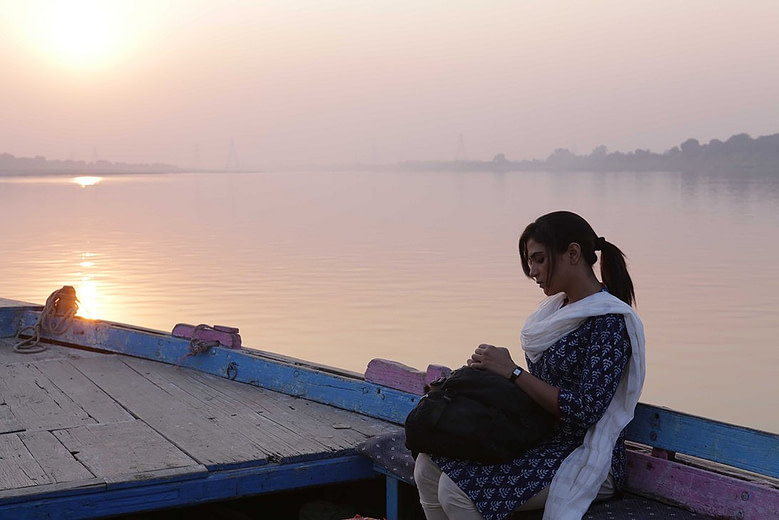
They are waiting for someone to stop calling them stains and instead see them as relic stones, resting on the upper shelf of an almirah. It is time for the man to rise from that bench, retrieve those stones from the cupboard, and carry them to the river. Smile at them, see them not as a hex but as souvenirs, and hand them over to the water. Let them sail away with the waves. Let them, for once, become lanterns, floating on the river, then lifting into the night sky.

Only then will they leave behind their impressions in the air, for us to finally breathe in.


